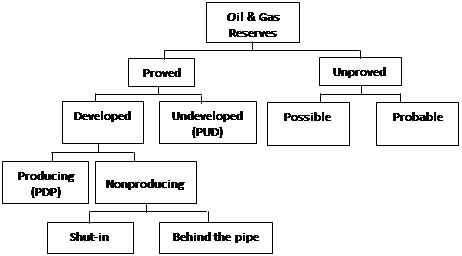
Proved reserves: Those reserves that on the available evidence are virtually certain to be technically and economically producible (i.e., have a better than 90 percent chance of being produced).
Proved field: An oil or gas field whose physical extent and estimated reserves have been determined.
Probable reserves: Unproved reserves that are estimated to have a better than 50 percent chance of being technically and economically producible.
Possible reserves: Unproved reserves that at present cannot be regarded as “probable” due to a low probability of profitable development. The industry standard probability that these reserves are technically and economically producible is 10 percent (or moderately higher).
Recoverable reserves: That proportion of the O&G in a reservoir that can be removed using currently available techniques.
Primary recovery: Recovery of oil or gas from a reservoir purely by using the natural pressure in the reservoir to force the oil or gas out.
The relationship among oil & gas reserves is illustrated below:
|