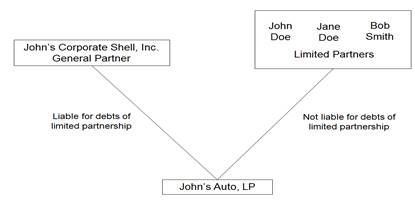
Limited Partnerships are legal entities created under state law. A limited partnership must have at least one general partner who retains personal liability. The general partner can be a corporation or LLC. The limited partners have limited liability for partnership debts (i.e., only their investment). A written partnership agreement and state filing are required. Limited partnerships generally receive the same tax treatment as general partnerships (i.e., partners are taxed for income of partnership).
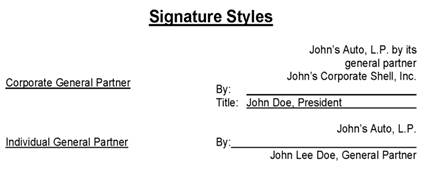
The loan file should include a copy of the Limited Partnership Agreement and any amendments.
The loan file should include a Certificate of Limited Partnership or Certificate of Formation. For a Texas limited partnership this may be obtained from the Secretary of State online at www.sos.state.tx.us or by telephoning (512) 463-5555. All limited partnerships formed in Texas on or after January 1, 2006 have Certificates of Formation rather than Certificates of Limited Partnership.
The loan file should include a Certificate of Fact: Status. For a Texas limited partnership this may be obtained from the Secretary of State online or by telephoning (512) 463-5578.
The loan file should include a Certificate of Franchise Tax Account Status. A Certificate of Franchise Tax Account Status (“CoAS”), commonly referred to as a “good standing certificate,” is available for limited partnerships doing business in Texas. The CoAS certifies whether or not the limited partnership is in good standing with its franchise tax reports and payments, or that the entity is exempt from the state franchise tax. This certificate provides the account status on franchise tax only. A CoAS may be obtained from the state office responsible for the collection of franchise taxes. In Texas this certificate is obtained from the Comptroller of Public Accounts by telephoning (800) 252-5555, or online at www.window.state.tx.us (click franchise tax account status). To determine the status of a limited partnership, select the CoAS Corporation Search page. Answers to your questions are available via e-mail at [email protected] or by telephoning (800) 252-1318.
The loan file should include a Partnership Resolution of Authority. Although one general partner may legally obligate the partnership, the author recommends that all general partners execute the loan documents or the Bank obtain a Partnership Resolution of Authority signed by all the general partners indicating which partners are authorized to borrow, pledge collateral or guaranty debt on behalf of the partnership. This avoids subsequent claims by the other partners that the signing partner was not authorized to borrow on behalf of the partnership. A sample form is located at the end of this Chapter.
The loan file should include a Certificate of Authority to Transact Business if the partnership conducts business in any jurisdiction other than its jurisdiction of formation. This may be obtained from the Secretary of State’s office or other appropriate official’s office in each of these other jurisdictions.
If a general partner is a corporation or LLC, the authorization documents for a corporation or LLC are also required.
If a limited partnership is doing business in Texas under an assumed name, a Certificate of Fact: Assumed Name which lists all of the entity’s assumed names (or specifies that none exist) may be ordered from the Texas Secretary of State. A copy of the Assumed Name Certificate should be obtained from the Texas Secretary of State and from the applicable county clerk(s). The Secretary of State Certificate may be ordered online or by telephoning (512) 463-5578. The Texas Secretary of State’s Assumed Name Certificate form, with instructions, is located at the end of this chapter. It may be downloaded from the Texas Secretary of State website. Forms for Texas counties must be obtained from the applicable County Clerk. The larger Texas counties have these forms available on line.
NOTE: The provisions of the Texas Assumed Business or Professional Name Act (located in the back of this Guide) require a limited partnership file its Assumed Name Certificate with the Secretary of State and, if the limited partnership is required to maintain a registered office address in Texas, in the county clerk’s office of the county in which the registered office is located and in the county of its principal office. In the case of a limited partnership that is not required to maintain a registered office address or that does not maintain a registered office address, the Assumed Name Certificate would be filed with the Secretary of State and in the county clerk’s office of the county in which its office is located in Texas. As of January 1, 2006 it is permissible to use the name of a limited partner in the limited partnership’s name.
EXAMPLE: The Bank makes a loan to a limited partnership. Its Certificate of Limited Partnership or Certificate of Formation lists the name of the entity as John’s Auto, L.P. The exact legal name of the limited partnership is John’s Auto, L.P. and that is the name which should be listed as the Debtor’s name on the UCC-1. If John’s Auto, L.P. does business under the name “Autoworld” the Bank should obtain an Assumed Name Certificate. Autoworld should not be listed as a debtor in the UCC-1.
NOTE: The name of a Texas limited partnership is sufficient for purposes of a UCC-1 financing statement only if that name matches the name shown on its Certificate of Limited Partnership or Certificate of Formation.