
“A general partnership is defined as two or more persons who manifest an intent to associate as co-owners in a business for a profit.” It is created by contract (oral or written) without the need for government filing (i.e., unregistered). Partnership agreements should be required for any partnership borrower, although a written agreement is not required by law. All partners are jointly and severally liable for the debts of the partnership. Partners are taxed personally for partnership income (including phantom income). For example, even if the partnership reinvests its profits and distributes net income to partners, the partners are taxed on their portion. Because of liability issues that are not present with other entities, general partnerships are not as popular today as in past years.
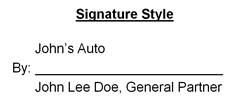
A copy of the Partnership Agreement should be required.
Although one general partner may legally obligate the partnership, the author recommends that all partners execute the loan documents or the Bank obtain a Partnership Resolution of Authority signed by all of the partners indicating which partners are authorized to borrow and pledge collateral on behalf of the partnership. This avoids subsequent claims by the other partners that the signing partner was not authorized to borrow on behalf of the partnership. A sample form produced and copyrighted by Wolters Kluwer is located at the end of this chapter.
The loan file should include a copy of the Assumed Name Certificate if the name of the partnership does not include the last name of each individual or other legal name of each general partner or joint venturer. This can be obtained from the county clerk’s office(s) in which the partnership conducts business. Note: An Assumed Name Certificate is valid for a term not to exceed 10 years from the date the certificate is filed.
If a partner is a corporation, LLC or limited partnership, authorization documents for that entity are also required.
EXAMPLE: John Lee Doe and Robert Lynn Smith form a general partnership and open business as John’s Auto Shop. The UCC-1 should list the name of the debtor as shown in its partnership agreement. If no such name is shown in its partnership agreement, then the names of each person comprising the partnership should be shown on the UCC-1. If the Bank wants to take a lien on the assets of the individual partners as well as the assets of the partnership it should also obtain a Security Agreement signed by John Lee Doe and Robert Lynn Smith individually and file a UCC-1 listing each individually. This is in addition to the Security Agreement with John’s Auto Shop and the UCC-1 listing John’s Auto Shop. The Bank should also obtain an Assumed Name Certificate because the last name of each partner (Doe and Smith) are not part of the name of the general partnership (John’s Auto Shop).
CAUTION: Even if a general partnership has a name, many secured parties, out of an abundance of caution, also will file separate financing statements naming each general partner as a debtor. When UCC-1s are filed against the individual partners note that UCC 9.503(a)(4) provides that the name of an individual debtor on a financing statement filed in Texas sufficiently identifies the individual debtor only if that name matches the name shown on his or her most recently issued and unexpired Texas driver’s license or unexpired Texas ID issued by the same office that issues Texas driver’s licenses. Revised UCC 9.503(a)(5) provides that if Texas has not issued a driver’s license or Texas ID Card to an individual, or it has expired, then the financing statement must reflect either (i) the individual name of the debtor (if he or she has only one name) or (ii) the surname and first personal name of the debtor.